 News
News
Scrubs versus ‘Suits’—a simmering turf war
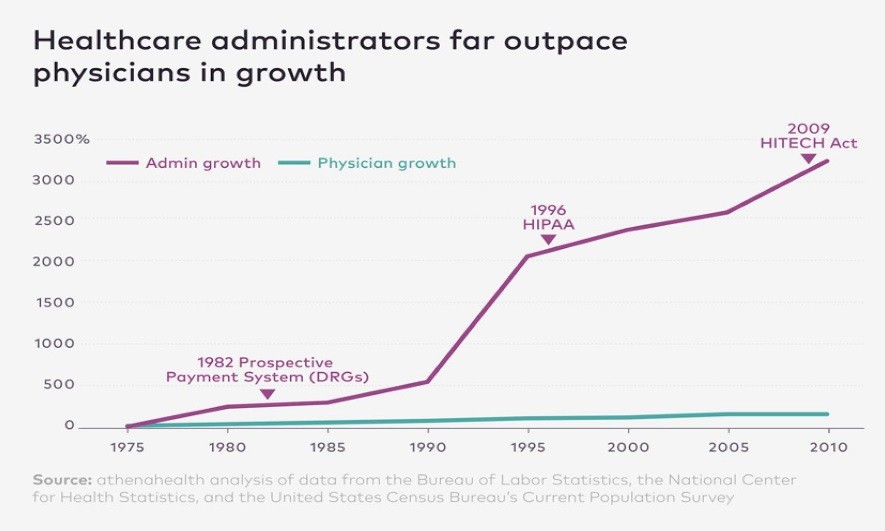
Pari passu with sibling rivalry between parallel and comple-mentary specialities, for example, cardiology and cardiacsurgery for wire-skills; there has been a turf war festeringbetween the ‘Scrubs’ (Clinicians) and ‘Suits’ (Administra-tors) [1]. This latter rivalry has assumed greater significancewith the corporate culture in medicine booming lately. ‘Thenumber of physicians in the United States grew 150 percentbetween 1975 and 2010, roughly in keeping with popula-tion growth, while the number of healthcare administratorsincreased 3,200 percent for the same time period ……astatistic derived by Physicians for a National Health Pro-gram using data from the Bureau of Labor Statistics, theNational Center for Health Statistics, and the United StatesCensus Bureau's Current Population Survey’ (Fig. 1) [2].Matters are unlikely to be any different in Indian privatehealth sector, especially in corporate hospitals.Proponents of the corporate governance structure justifythese burgeoning number of healthcare administrators by thefelt-need of complexities of governance—brought about bycut-throat competition, ever more complex regulatory com-pliance requirements, and medicine becoming more tech-nologically oriented. Even the legal, insurance, reimburse-ments, and finance-related issues call for special skill sets,not within the purview of an average clinician.
The opponents and critics, to the contrarian, cry foul thatthis army of administrators do precious little to reduce theclerical burden on clinicians; and it is them, the medicalprofessionals, who are at the receiving end when things goawry. Public reporting of outcome data and maintenanceof a lot of medical records for accreditation purposes addto the woes of the clinicians. Moreover, the terminologiesand the language used by these professional administratorsare straight from the commodity market and do not strike achord with the patient-centric, empathy-based, affective skillset and thinking of a practicing clinician, besides irritatingtheir not-so-subtle ego, thereby bringing disenchantment tothe practice of medicine. All this impairs doctor-patient anddoctor-doctor interpersonal relationships too, and is quiteoften seen as an open discord in some hospitals, and as asimmering dissatisfaction in others. As a corollary thereof,collateral damages emanating, like burn-out, depression,and psycho-social issues, too are not inconsequential. Asif all this was not enough, adding fuel to the fire, industry,and market force–driven evanescent novel technologies andephemeral therapeutics, of doubtful efficacy, add to the intri-cacies of governance and each warring faction claims felici-tousness in handling matters, with no convincing evidenceone way or the other.
Corporate hospitals’ governing hierarchy is based on themotto of profit-driven finance management, intervention-based human resource development, and business-generatingmarketing professionals with very little room for holistic,organically driven, and clinically oriented medical profes-sionals. They rely on complex, and at times convoluted,models of marketing and business development, which arebased on learnings from the schools of management, withvery little inputs from the bedside. This top-heavy mecha-nisation of the administrative side in the corporate hospitalsadds to the burgeoning cost of healthcare. In a recent studyfrom North America, prices in physician-owned hospitalswere about one-third less than non-physician owned corpo-rate hospitals across eight common services in a designatedarea [3]. Ultimately, all these extra costs are being paid bythe patients, who have to bear the ever increasing cost ofhealthcare, driving more and more people from poverty topenury. Additionally, even outcomes are better, ‘Ample evi-dence also suggests that physician-owned hospitals enhancephysician engagement, provide higher-quality care, and haveimproved patient satisfaction, lower costs, and better infec-tion rates compared with their competitors’ [4].
Therefore, there is an acute need for an open and society-based debate on this issue of serious import, to not only thepatients and doctors, but in fact to the entire society. Thesooner we develop the right balance, and the degree to whichthis corporate governance structure should evolve, would bebeneficial for the ‘health of the healthcare’. More Info https://shorturl.at/13AYo
- NHI